Sign Services
Building signs and relationships that last!

Sign Face Replacement
Updated: July 30, 2025
Contents• Sign Faces: Built for Performance, Not Just Appearance
• Why Thickness Matters
• What Are Hotspots—and Why Should You Care?
• Face Types and Materials We Use
• Vacuum Formed, Embossed, and Pan Faces
• Push-Through Faces: Precision + Illumination
• Old vs. New: The Risks of Aging Sign Faces
• What Sets Us Apart
• Serving OH, KY & WV with Signs That Stand the Test of Time
Sign Faces: Built for Performance, Not Just Appearance
At Sun Sign Company, we believe quality doesn’t happen by accident—it’s built into every layer of the sign, starting with the face. While many companies cut corners to win on price, we’re committed to delivering value through smarter material choices, better engineering, and attention to long-term performance.
From Main Street storefronts to highway pole signs, sign faces are where first impressions happen. And behind that clean exterior is a lot of science.
Why Thickness Matters
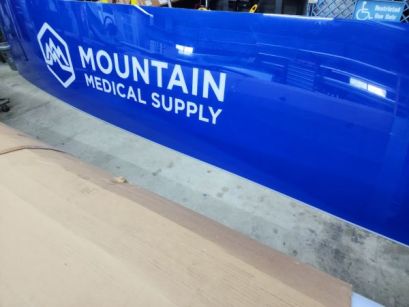
A sign face’s thickness isn’t just a spec—it’s a critical performance factor. Thicker faces resist wind deflection, provide better structure for large spans, and minimize surface rippling over time. For most of our outdoor signs, we use .177 UV-protected polycarbonate, known for its toughness and clarity.
Our competitors often shave cost by using lighter materials—but this leads to failures like warping, stress cracks, and catastrophic blowouts in strong windstorms.
What Are Hotspots—and Why Should You Care?
If you’ve ever driven past a sign and could count the number of bulbs or LED modules behind the face, you’ve seen hotspots in action. They happen when light isn’t properly diffused—usually caused by:
- Too-thin face material
- Lack of light management film
- Improper second surface vinyl installation
We combat this with light-diffusing films engineered to reflect and redirect internal light. For example, a 30% diffuser allows 30% of light to pass while bouncing the other 70% around the cabinet, evening out brightness and eliminating harsh glare.
We routinely use 30%, 50%, 60%, and 70% diffuser films depending on face material, lighting source, and the effect you want.
Face Types and Materials We Use
We don't believe in one-size-fits-all. That’s why we design sign faces using a range of materials and techniques, chosen for your application—not our bottom line.
- Polycarbonate (clear or white) – UV resistant; ideal for outdoor signs
- Acrylic and polycarbonate – for indoor or protected signs
- Routed aluminum, steel, stainless steel or acrylics – for durable cut-through faces
- Wood or high-density foam – often used for monument or custom carved signs
- Printed fabric and vinyl – lightweight solutions for large-scale signs or high-mount installations where wind load is a concern
Each has its own place—and we’ll explain why we chose it when we design your sign.
Vacuum Formed, Embossed, and Pan Faces
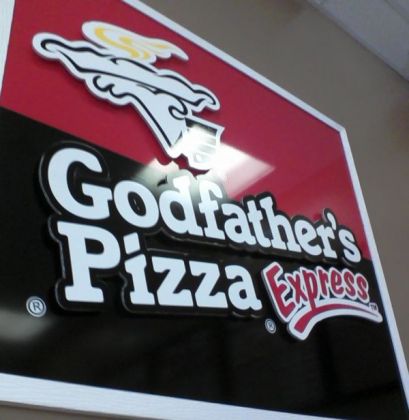
Pan faces, embossed designs, and cloud shapes are formed from vacuum-molded polycarbonate—a process we sublet to a trusted Ohio supplier we’ve worked with for 15 years. Their standards match our own, and the results speak for themselves.
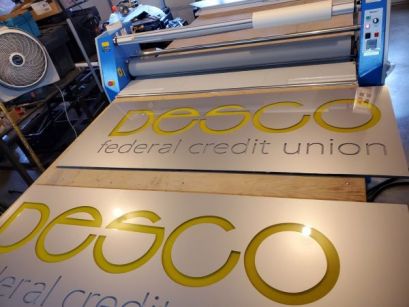
These formed faces are often second-surface treated: layered with vinyl, then back-painted white to enhance reflectivity and help manage lighting. Done right, the result is a bold, clean presentation that looks just as good after dark.
Push-Through Faces: Precision + Illumination
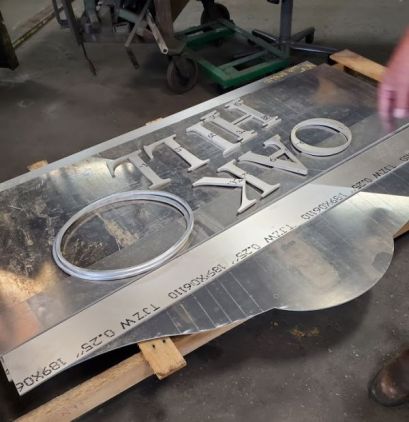
Push-through faces are growing in popularity for illuminated wall signs and monument applications. Here’s how they work:
- A design is cut into aluminum or composite face material
- Acrylic letters are routed and inserted from behind
- Letters are painted or laminated with translucent vinyl
- Internal lighting makes the letters glow from within
This gives a high-end, dimensional appearance that’s both professional and energy-efficient.
Old vs. New: The Risks of Aging Sign Faces
Older sign faces often can’t handle today’s brighter LED lighting. They were built for fluorescent lamps and lack proper diffusion properties. Over time, polycarbonates become brittle from UV exposure, leading to dangerous sharp edges if they crack or break.
We frequently replace faces that were underbuilt from the start—too thin, poorly diffused, or improperly sealed. Don’t let that be your sign.
What Sets Us Apart
Some companies win bids by skipping steps: thinner material, no diffuser film, or outdated face tech. We don’t.
Instead, we design and build sign faces to:
- Last longer under tough outdoor conditions
- Resist yellowing, cracking, and blowouts
- Reduce maintenance and improve safety
When you buy a sign from Sun Sign Company, you’re investing in quality that’s engineered, not improvised.
Serving OH, KY & WV with Signs That Stand the Test of Time
We’ve built sign faces for banks, schools, car dealerships, churches, convenience stores, and municipalities across Ohio, Kentucky, and West Virginia. Whether your sign is 8 feet up or 80 feet in the air, we know how to build it right.
📍 Request a Quote | 📄 Learn About our Quality Sign Construction | 🔧 Explore Our Sign Repair Services