Quality Sign Construction
Building signs and relationships that last!

Sign Fabrication and Welding
Updated: October 25, 2025
Contents• Sign Fabrication and Welding – The Backbone of Every Quality Sign
• Aluminum: Our Standard for Strength on Sign Cabinets
• Reinforcing Critical Stress Points
• Welding Methods: Chosen for the Job
• Pole Fabrication: Where Loads Live
• Built on Engineering, Not Guesswork
• What This Means for You
Sign Fabrication and Welding – The Backbone of Every Quality Sign
When a sign stands tall year after year, it’s never by chance—it’s the result of solid work behind the scenes. At Sun Sign Company, the core of every project begins with fabrication and welding that is, first, purposely planned, then deliberately and accurately executed. This is where strength and longevity are built in - long before decorative graphics or sign lighting ever come into play.
From the very start, we construct a framework that's designed and engineered to withstand howling winds and the harsh weather that's all too common throughout the mountains and river valleys of Ohio, Kentucky, and West Virginia. We take pride in ensuring that every sign we create is not only visually appealing but also durable, standing as a testament to the hard work and expertise that goes into each project. .
Aluminum: Our Standard for Strength on Sign Cabinets
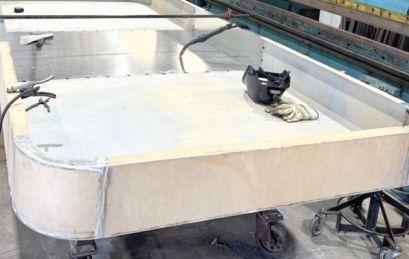
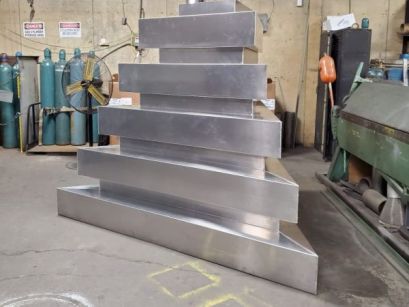
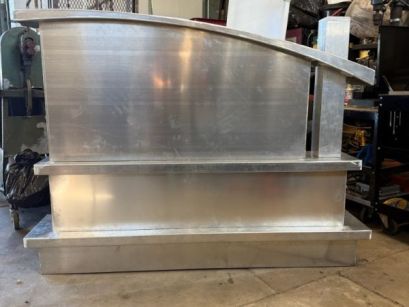
Most cabinet and box-style signs start from raw sheet aluminum we keep in stock in thicknesses of .080, .090, and most commonly .125 (1/8"). For smaller, light-duty cabinets (single or double-sided), we also keep .125 extrusions in 24-foot lengths (4", 6", 8", 10"). On larger builds, we fabricate with .125 aluminum or a heavier gauge almost exclusively, applying brakes (bends) for added rigidity and reduced flex across wide panels.
Reinforcing Critical Stress Points
Durability is engineered into the details. We cut and install corner gussets, add reinforcement plates at lifting rings and mounting locations, and ensure every surface is squared, cleaned, and aligned before welding. The result is a stable, repeatable base that allows our welder to work his magic to obtain maximum attachment strength.
Welding Methods: Chosen for the Job
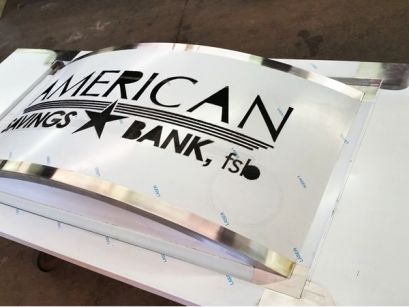
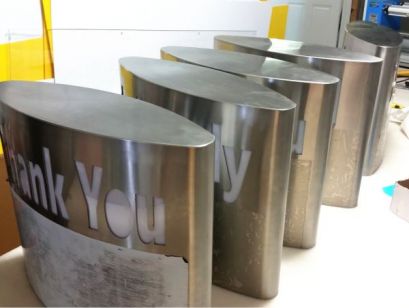
There’s no one-size-fits-all. Most aluminum cabinets are MIG welded with wire and shielding gas selected for the specific alloy and application. When the project calls for stainless, we fabricate in stainless steel and utilize TIG welding for clean, precise, corrosion-resistant joints. Our lead welder is a journeyman, welding instructor, and certified welding inspector, so seams fuse properly, joints align, and welds pass scrutiny.
Pole Fabrication: Where Loads Live
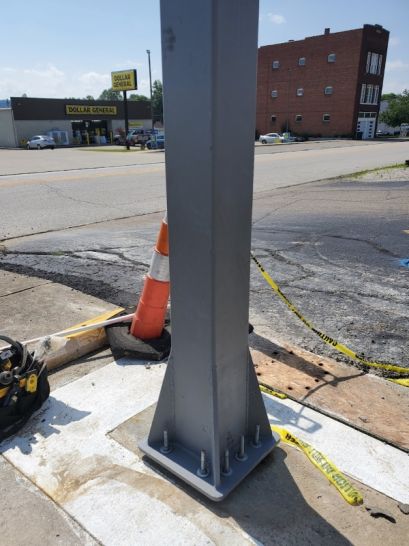
Cabinets get attention, but poles carry the load. We fabricate gusseted baseplates at the bottom for anchoring poles to concrete foundations and top mounting plates to secure cabinets to the pole. Typical pole signs include a nested internal support pole that seats into the main shaft a foot or two and extends through the cabinet to the top, creating a rigid spine that distributes weight and resists flexing. These are critical welds performed to exact tolerances.
When it comes to materials, we most often choose steel poles because of their superior strength. While aluminum offers corrosion resistance, it doesn’t provide the stiffness needed to safely support heavy cabinet signs or large digital displays. Steel flexes less under stress, allowing pylon signs and poles to stand more than 100 feet into the air without compromise. It is also more resilient to repeated stress cycles, meaning it can handle years of gusty winds without suffering fatigue or failure.
Built on Engineering, Not Guesswork
We don’t fabricate from the seat of our pants. Every structure we build follows plans stamped by licensed engineers—not generic templates. Designs are computer-tested to withstand regional wind and snow loads and adverse weather scenarios. Some shops rely on rules of thumb; we combine engineered precision with proven fabrication practices so your sign is certified to perform when it matters most.
Learn about Sign Design, Engineering and Permits
What This Means for You
Choosing Sun Sign Company means strength you can trust and reliability you can count on. Cabinets and poles are custom fabricated from superior first grade materials, and built by some of the best craftsmen in the business. They are reinforced at stress points, and welded by experts—then validated against engineered plans and subjected to rigorous inspections. Your sign isn’t just a display; it’s a long-term structure that represents your brand every day. And when you consider how much a sign communicates before a customer ever walks through your door, it’s clear: the structure behind the sign is every bit as important as the message on the face. That’s why we build signs to last—not just for today, but for the many years of business growth ahead.
Explore related topics: Engineering & Permits • Pylon Signs • Pole Signs • Sign Installation